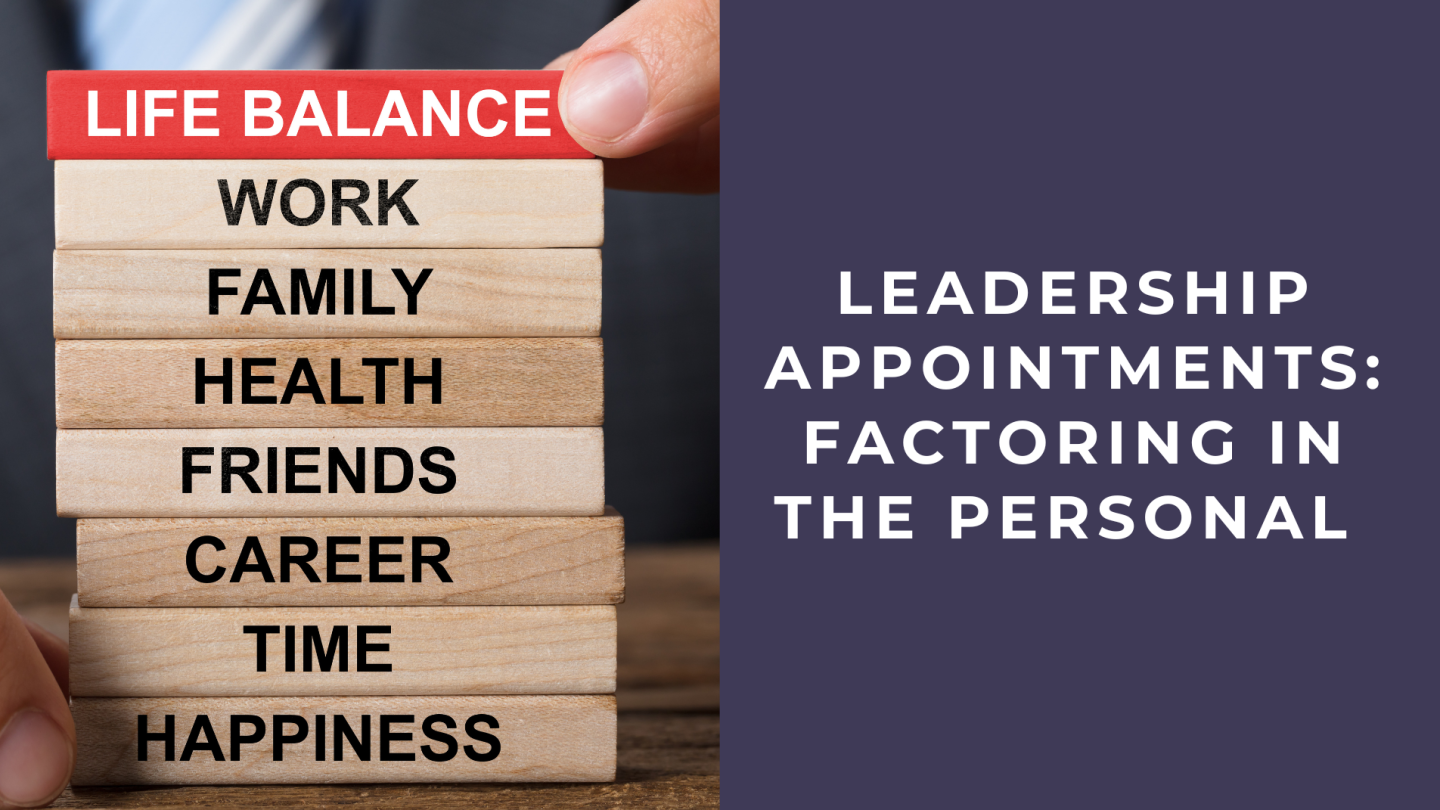
Leadership Appointments: Factoring in the Personal

A successful leadership appointment is usually seen as a match between a candidate and the requirements of the role.

In international appointments, these requirements can be many and various. Some will be tangible and even non-negotiable and externally-regulated – levels of experience and qualifications, for example. Others will relate to the priorities and challenges of the role. Some requirements may be clearly articulated in a person specification; others may be less easily described. 

Equally, candidates will have their own professional expectations. When we speak to candidates, we consider where they are in their career and what they are seeking next. They may have a specialisation in mind or a gap to fill. At Principal level, divergent pathways are becoming more possible as the sector diversifies further: some candidates are more interested in roles where they can focus on being an educational leader, while others seek a wider range of responsibilities. 

This is all about the professional match. But there must always be a personal side. Many candidates seem on less comfortable ground here. Some do not take enough account of personal and family alignment, which can quickly lead to appointments not working out. Others swing the other way, unintentionally overplaying their hand and overstating their intentions. One common trap is translating expectations from one role onto another without recognising that they can be met in different ways. 

This article explores some of the personal dimensions. It deliberately does not discuss navigating the package – that is for a future article.  

The unambiguous factors 

Some personal dimensions of an appointment will be obvious. A school may be in a remote location and a family will require resourcefulness and self-sufficiency. There may be visa-related restrictions that will rule a candidate out: age, most typically, but it is always worth looking at any health-related exclusions – and how many candidates know that you cannot lead in some countries with a theology degree? 

Sometimes, candidates will have their own clear lines: family circumstances mean they don’t want to be more than an X-hour flight from home, or they have ruled out certain areas on safety or other grounds, or they can move this year but not next year because of a child’s education. And let’s not forget the most common of all: can we take our dog? 

These are the easy ones. Most of the personal influences on decision-making are much more ambiguous.  

The importance of feeling comfortable 

Personal circumstances and requirements need to be discussed during the process – another reason why informal conversations with recruiters are so important. Getting issues on the table early saves time and perhaps also emotional commitment. But even then, a real assessment of some issues may only be possible at an in-person final interview stage. We are never wholly comfortable when there is not a final stage in the school. We all had to work that way during the pandemic, and decision-making felt riskier as a result. 

Final stages really are two-way affairs. A school gets to see candidates in the round, in various scenarios, engaging with different stakeholders and in the specific cultural context. But the candidate can start to visualise what life would be like – the reality of the school, of course, but also the domestic arrangements. Can they imagine their family being comfortable and enjoying life there? It’s not always possible, but better still if a spouse or partner is there to help make that decision.  

I remember one final stage many years ago when the preferred candidate withdrew before boarding his flight home. It was an emotional decision because the job was an outstanding opportunity for him, but he and his wife simply could not see themselves living in that location. They had needed to see and feel the place to make that decision. It was a good outcome: better to make the decision then than three months in (and there was another eminently appointable candidate who served the school well for many years). 

The Family Fit 

One candidate recently put the importance of family nicely: ‘I’ll only be able to do the job I know I can do if I feel sure my family are happy.’ Conversely, it is not uncommon to hear; ‘My husband/wife/son/daughter just didn’t settle.’ There is much more to this question with an international move than when moving within a country. 

Schooling options may be an important factor if a child’s age group is not covered by the school. What are the options, where do other staff children go and is transport organised? 

At a final stage, there should be a chance to view accommodation options. Is there a set accommodation option or does an allowance enable a leader to weigh up convenience, comfort, lifestyle choices and safety? Where do other staff live – and can you speak to them about their experiences? But respect the location. One candidate made a fuss about accommodation being in an apartment when his family was accustomed to a house – in a society where almost everyone lives in apartments. 

It is perfectly usual in some countries for a Principal to have a car and driver; it is absolutely not the case elsewhere. There is no right or wrong and this is a good example of why it can be problematic to carry expectations from one role to another. If you prefer to have a driver, then perhaps you should be looking in a location where that is the norm.  

A partner’s expectations of employment is a factor for some – whether in the school (sometimes this is not permitted), in another school or elsewhere. Occasionally, a school may be able to offer options, but that should not be taken for granted. Realistic expectations are important. Sometimes we hear: ‘Oh, he/she has a business that is largely online and they can work anywhere.’ But can they? Because we also hear: ‘He/she couldn’t really keep their business going so we have lost an income and need to look elsewhere.’  

Cultural alignment 

Aligning with the school culture is worth a whole separate article. The issue here is alignment with the host culture. Some of that can be researched in advance, some of it needs a visit. 

An example may best illustrate the point. This concerns an experienced leader at a final stage in China. Although he had worked in diverse countries, some of them very challenging, he had never worked in China. He was noticeably uncomfortable: he showed little curiosity when we were on a tour, he would be the first back in the vehicle when we moved on, and he seemed uncharacteristically offhand with local people he encountered. When we talked later, he described his surprise at how uncomfortable he had felt. If the school had ignored the red flags, he should probably have decided it was not right for him. It is unlikely he would have been happy. 

Curiosity can be a good indicator of alignment – how interested does a person seem in the surroundings, what questions do they ask, are they keen to see more, how do they relate to staff from the country. That’s something for a school to observe. But it’s also for a candidate to weigh up – how would they, and their families, feel, if they were immersed in the society. If it doesn’t feel right, then maybe that should be heeded. 

Opportunities to develop 

Schools are far from equal in their approach to professional development. Even when there is decent provision for teachers and staff, the idea of a senior leader’s continuing development may be off the radar. In part this can be is a cultural issue – if a school supports the leader’s development, won’t they soon fly the nest? Senior leaders will understandably want to know that there are opportunities to develop – will they will have access to coaching or mentoring, or time to participate in sector or regional networks, or to maintain inspection or accreditation commitments? Some groups and schools have impressive PD offers for all staff, and evidence of this on their websites is a positive sign – although its absence is certainly not an indication to the contrary.  

A conversation will give you a sense of your room for manoeuvre. But don’t paint yourself into a corner. One recent candidate produced a list of expectations around time for inspection training, support to pursue external qualifications and various other commitments such that even we questioned how much time he actually wanted to spend in the school. 

Treat it as a conversation 

Moving internationally can be an enormous undertaking for a leader and their family, full of the richest rewards when it works well. There is a lot to factor in.  

A position may be the perfect next step in career terms. But if it is not likely to work well for a family, then it will not be so perfect in reality. These are not trade-offs: an international move must be viewed holistically. 

Our advice is to start the conversation early so that by the time you apply for a role, you have been able to consider your main concerns. We certainly won’t have been able to give you all the answers, but it is a case of keeping the questions flowing (appropriately) as the process unfolds.  

Don’t overdo it so that your legitimate questions come across as though you are setting your own high price. But do take advantage of the informal earlier conversations, and then the final stage when you get that far. It really must be a two-way thing. A school wants maximum confidence in its decision. But you also need to be confident as you picture yourself and your family in the school, in the country, the city, the apartment complex, at the mall or the market, in the gym, at a restaurant. There are always risks but the best processes will give you chances to investigate them. The most successful school leaders will be happy professionally because they will be settled personally.  


Cultural Intelligence for International Leaders

Chris Edwards, Senior Advisor

“You’d think I’d know how to spell my name, wouldn’t you?”  

I offered this mildly inane pleasantry as I returned the clipboard to the university-educated senior member of the Administration team. The pen had slipped as I’d been scribbling my signature at the bottom of a page that had been resting on an unsteady arm. But instead of the polite, indulgent smile I’d been expecting, I received a matter-of-fact response which could not completely mask the trace element of disappointment:  

“Yes. You have a degree in English from the University of Oxford.”  

But then it was my first week as Head of a school in Singapore, and I had yet to learn that the self-deprecation that had served me so well in the UK and in an earlier international role would not land as successfully in my new surroundings. Now, many years on, and having interviewed and exchanged views with hundreds of sitting and aspiring international Heads, I am more convinced than ever that technical competence can get you hired, but cultural intelligence may well determine whether you last.  

In 2003, scholars Christopher Earley (London Business School) and Soon Ang (Nanyang Technological University) published Cultural Intelligence: Individual Interactions Across Cultures. Sadly, I didn’t read the book until twelve years later, by which time, despite my good intentions, I had unwittingly misread, domesticated, coloured, overlooked, transposed and caricatured interactions that deserved far more from me.  

Your Cultural Intelligence Quotient, or CQ, is about more than not flaunting the soles of your shoes in the Middle East. Typically, it is described across four dimensions: the cognitive (knowing about other cultures), the motivational (wanting to engage with cultural difference), the metacognitive (thinking about how you think across cultures), and the behavioural (actually adapting your communication and conduct).   

I would suggest most school leaders get to grips pretty quickly with the cognitive (after all, much of that can be learnt through reading). Things become trickier once we reach the metacognitive and behavioural elements. Retaining your authentic self while navigating unfamiliar social and even moral environments requires some of the unlearning discussed in an earlier article. We all know that overlaying those successful years in Buenos Aries onto the new post in Abu Dhabi and expecting the same result is only going to end one way; but for a veteran Principal especially, it can still be a difficult trap to avoid. Unless one is sensitive to the danger, confidence tends to calcify into assumption.   

An obvious example of where a high CQ is advantageous is in establishing whether your relationship with a board or owner exists in a low context environment where communication is usually explicit, direct and literal, or a high context environment in which implicit and indirect communication (including non-verbal cues) are standard. Given the international make up of some boards, a Principal may face a hybrid of the two. One must be careful when generalising about particular regions not to employ the very stereotypes a high CQ teaches you to avoid, but I think most Principals would recognise that there is a difference between, say a North European or North American governance model and a Gulf or South Asian context. In the case of the former, a Principal will often feel that the reservoir of trust will deepen if she is direct, transparent, quick to surface problems and keen to generate debate. Little if any thought will be given to concepts like “face”, preserving collective dignity, deferring (in public at least) to hierarchy and patiently cultivating relationships before task focussed interactions commence. But the calculus is markedly different as one moves East and South, and these concepts – alien to many Principals – may become increasingly crucial to success.   

An example may be helpful. Challenging an individual board member in a group setting may be the sign of a strong leader in a North European/American context, but it might lead to shame and embarrassment for both parties in the Middle East and Asia. Essentially, you might lose trust when you apply the wrong model. The Principal who is too circumspect in a low-context culture should not be surprised if they are viewed as secretive or even incompetent. Conversely, the Western principal who demands “radical transparency” in a high-context culture could be seen as embarrassingly naive or dangerously indiscreet. Elsewhere, CQ is just as important. A Brazilian international school Principal will want to get to grips with the special nature of jeitinho relationship, which help get things done in difficult bureaucratic circumstances. In many parts of Africa, Heads might be dealing with collectivist cultures in which community alignment trumps any positional authority. And so on. There is no workable global template.   

Approaching every new position with cultural curiosity (as opposed to cultural certainty) is vital. Leadership does not work the same everywhere. Building as much foundational knowledge as possible around social norms, communication styles, political landscape etc. is self-evidently important, but understanding the logic of a culture is crucial: how do people interpret authority, trust, conflict, collaboration? On arrival at a new school, a Principal should take time to listen for what is unsaid, and notice who speaks, who defers and who influences. How direct or indirect is communication, and why? Will you need to be more patient with decision timelines? Are you comfortable with the levels of deference required to get things done? Are you still bringing assumptions to meetings rather than curiosity and humility (neither of which preclude strength)? And do you have a cultural mentor: somebody who can help you reflect on and be flexible within a new cultural paradigm without compromising your core values?  

So CQ is an ongoing discipline. I’d like to think my mistakes became fewer as I immersed myself more into a host culture, but I continued to make them. Just before Covid struck, I went from Singapore to New Zealand where, as a coda to my career as a school leader, I was tasked with setting up Green School New Zealand. This involved downsizing initially by a factor of 100 (from nearly 6,000 to 60 students), and appointing the Head and the Board. But it also necessitated working very closely with the Māori community, on whose sacred land the school lay. I had worked on four continents beforehand and run one of the biggest international schools in the world, but, frankly, it counted for almost nought: all at once I was an ingénu again. Whanaungatanga, the slow building of genuine personal connection, was foundational; nothing could happen without correct approaches to Iwi (tribe) and Hapu (sub tribe); I learnt and respected the seminal status of Tikanga (protocols) and Kawa (customs); and I grew to understand the almost transcendent nature of Manu and Tapu which shaped how people related to land, to space, and to each other. Here, as in all new cultural environments, success would only follow if one approached every interaction with humility, curiosity, and adaptability. Had I employed the same modus operandi in Taranaki as I had in Sao Paulo, or Buckinghamshire, or Singapore, the lights would have gone out very quickly.  

CQ involves the ability to understand how cultural expectations shape leadership, authority, communication, and trust. I would suggest that it is not an optional attribute of an international Principal; it is a defining competency.    


“How is my child really doing?” – and why the answer doesn’t always create clarity

What our research shows about feedback and where schools can focus their efforts 

Drawing on our proprietary research across the independent sector, including large-scale surveys and interviews with thousands of parents, one issue stands out with unusual consistency: how parents experience feedback on their child’s progress. 

In around 80% of our parent surveys, it emerges as a top priority for improvement. 

This is not confined to one phase. It spans the age range, though it is often expressed most strongly by parents of younger pupils. Nor is it a marginal concern. For many families, feedback is the primary lens through which they judge both the quality of education and the strength of their relationship with the school. 

At its core, this is not simply a question of communication frequency. It is a question of confidence. 

Parents are asking, in effect: Do we understand how our child is really doing, and can we trust that the school will tell us early if something needs attention? 

At the same time, school leaders will recognise the practical constraints. Teacher workload is already under pressure, systems are often complex, and fully bespoke, high-frequency reporting is neither realistic nor desirable. 

The issue, therefore, is not how to do more, but how to ensure that what is already in place carries greater clarity and confidence for parents. 

Across our research, the pattern is consistent: dissatisfaction rarely stems from a lack of information, but from a lack of clarity about what that information actually means for their child. 

What sits beneath parental expectations 

When analysed across datasets and schools, parental feedback on this topic is remarkably consistent. Rather than a long list of disconnected requests, the same underlying expectations recur across contexts. 

1. Regular, timely communication 

Parents are not seeking constant updates. However, reliance on a small number of formal reporting points creates risk, because when communication is episodic, issues can feel sudden rather than managed. 

What parents respond to most positively is a sense of continuity: that progress is being monitored and that any concerns will be surfaced in a timely way. This is especially true for parents of younger children. Typical comments include:  

“It would be really helpful to keep parents updated on a more regular basis… rather than having surprises in reports or parents’ evening.”  

“The short slots at parent’s evenings don’t allow for much discussion. Could the school look at ways to improve communication between teachers and parents throughout the year?” 

The underlying expectation is not constant communication, but the reassurance that nothing important will come as a surprise. The goal is to ensure that no parent reaches the end of term feeling they had no visibility of a concern. In practice, this is a shift from a series of planned events to a more continuous sense of dialogue, whether through dashboard reporting, interim updates or more accessible touchpoints. 

2. Evidence over general reassurance 

Parents consistently distinguish between tone and substance. Positive, supportive language is valued, but without clear evidence it can feel insufficient. 

Generic phrasing without data or context (“doing fine” or “no concerns”) is one of the most frequently cited frustrations. Parents are looking for feedback that is anchored in observable indicators of progress and provides enough context to interpret what those indicators mean. 

One typical comment illustrates this: “Very little granular detail about progress… the report simply listed exam scores without any context.” 

What builds confidence is not more commentary, but more meaningful detail. Parents are explicit about wanting honesty and clarity. They want to know whether their child is performing above, at or below expectations, and in which areas. In the words of one parent “instead of saying ‘he is bright’ or ‘no areas of concern’, give clear, detailed feedback.”  

3. Insight into the individual 

Confidence is closely linked to whether feedback feels genuinely personalised. Where comments appear formulaic or interchangeable, parents tend to question how well their child is known. 

Conversely, even brief but specific references to a child’s work, behaviour or development are highly valued. They signal professional attention and strengthen trust. 

This becomes particularly important in senior settings, where parents often look to a form tutor or equivalent to synthesise a “whole child” perspective. As one parent noted: “It would have been nice… to share how my daughter is doing beyond academics.” 

When feedback reflects the individual in a credible way, parents are far more likely to feel that the school truly understands their child. 

4. Direction, not just diagnosis 

Finally, and perhaps most importantly, parents are looking for forward-looking clarity. Parents are not only interested in current performance; they want to understand trajectory. This comes up repeatedly in our research. 

They want to know what will happen next, what support will be put in place, and how they can play a role. A typical quote illustrates the point: “More communication with parents on how their child can improve… sharing key pointers on how your child can improve would help us support them at home.” 

Without this, feedback answers the question “how are they doing?” but not “what happens next?” 

Where confidence is most often undermined 

Across schools, similar patterns tend to weaken parental confidence. These are rarely the result of major structural issues, but of smaller, cumulative inconsistencies. 

  • Delayed communication is one. Parents are generally pragmatic about challenges, but far less comfortable with discovering them late. 
  • Ambiguity around responsibility is another. Even in well-organised schools, parents are not always clear who holds oversight of their child’s overall progress. 
  • Consistency also matters. Variation in the quality of feedback between teachers is quickly noticed and can influence wider perceptions of the school. 

None of these issues are typically structural failures. They are more often the cumulative effect of small inconsistencies in timing, clarity and ownership. 

Differences by phase 

While the underlying expectations are consistent, it is helpful to recognise how their emphasis shifts across the school journey. 

In prep and junior years, feedback is closely tied to reassurance. Parents are looking for visibility: that their child is known, settled and developing. Brief, specific insights often carry more weight than longer, less frequent reports. 

In senior years, the focus moves towards clarity and trajectory. Parents want to understand how current performance connects to future pathways. The strongest senior phase feedback connects the dots between effort, outcomes, strengths, subject choices and the future. 

Regardless of phase, early visibility supports confidence more effectively than retrospective explanation. In other words, “We just want to know how they’re really doing.” 

Where schools can focus their efforts 

The practical question for schools is where to focus effort in a way that is both effective and sustainable. Our research suggests that improvements in this area rarely depend on significant new systems. More often, they come from refining existing practice. 

Common areas of focus include: 

  • Introducing a mid-point check to reduce the likelihood of surprises, particularly for new joiners 
  • Making more effective use of data already collected, so that progress is visible and interpretable 
  • Supporting staff to provide feedback that is specific and evidence-informed, through shared expectations and examples of effective practice 
  • Ensuring that each feedback point includes a clear next step 
  • Clarifying who holds the “whole child” overview for parents. 

In our experience, these are not high-burden interventions. They are targeted adjustments that improve clarity, consistency and, ultimately, parental confidence. 

A final reflection 

The strength of feeling around feedback that we see in our research is not about volume of communication. It reflects parents’ need to feel confident that they understand how their child is progressing, that nothing important will be missed and how today’s progress connects to what comes next. 

When feedback achieves that, it becomes one of the strongest foundations of trust between families and schools. 

When it does not, parents tend to sense the gap early, even if it is not immediately visible to the school. 

If you would find it helpful to understand how feedback is experienced in your own school, we can design and deliver tailored parent research and place your findings in the context of our wider sector benchmarks, helping you identify where small changes could make the greatest difference. 

Contact us at info@rsacademics.com or share your details here

Philanthropy and Leadership: Why Senior Leaders Should Be Involved

In many schools, fundraising is seen as the responsibility of the Development Director. While they should be the primary orchestrator, there is no fixed formula for who makes the ask. The Head, Development Director, Chair of Governors or another senior figure may all play a role. What matters most is that senior leaders are involved.

The Head’s engagement is often the single most influential factor in a school’s fundraising success. Yet across the sector, many senior leaders remain on the margins. Some feel unsure about their role, others are simply not invited in. This detachment can limit a school’s fundraising potential and overlook a valuable opportunity for leadership development.

From our experience supporting schools through consultancy and recruitment, we see a clear pattern. Leaders who are willing to ask far outnumber those with deep, regular experience of doing so. This isn’t a criticism. It reflects how fundraising has traditionally been approached. But things are changing and senior leaders have a vital role to play.

The case for involvement

With financial pressures increasing and the need to diversify income streams becoming more urgent, philanthropy has the power to transform a school’s future. We’ve seen this in higher education and now, in a small but growing number of schools this lightbulb has gone on and they are reaping the rewards.

Deputy Heads also have an increasingly important role to play in development. Many schools now include experience of fundraising and stakeholder engagement in Headship job descriptions, recognising development as a vital leadership competency. Deputies often have greater capacity than Heads to support day-to-day activity – providing senior visibility at events, helping to embed a culture of philanthropy across the school and contributing to stewardship through their existing relationships with staff, parents and pupils. Involvement in development is not only beneficial to the school; it also supports deputies’ own professional growth and readiness for future leadership roles.

Fundraising works best when it’s a team effort. More players on the pitch, each knowing their role, leads to more wins. While the Head may be the figurehead for the school’s largest donors, the next generation of supporters is waiting to be engaged, inspired and encouraged to begin their philanthropic journey.

Most development offices are small. Their capacity to build and sustain relationships is limited. Yet the number of alumni and parents capable of making influential or transformative gifts is far greater than the number who can be actively engaged by the development team alone.

This is where senior leaders can make a real difference. By collaborating with development professionals, they can help expand the school’s reach and deepen its relationships. That doesn’t mean taking over. It means showing up, listening well and being part of the conversation.

What the data tells us

The latest IDPE benchmarking report (2025) shows a clear shift in leadership engagement. 61% of Heads now spend more than 5% of their time on development, compared to 51% just two years ago. This is a meaningful increase and reflects a growing awareness of the strategic importance of philanthropy.

In schools raising the most money, Heads are significantly more involved than average:

  • 79% are actively cultivating prospects, compared to 59% in other schools
  • 69% are asking for or closing gifts, compared to 46% elsewhere

This level of engagement doesn’t just correlate with success. It helps drive it. And where Heads are more involved, wider staff and pupils are more likely to be engaged too. Development becomes part of the school culture, not just a standalone function.

What it looks like in practice

Here are some practical ways senior leaders can get involved:

  • Meet with your Development Director to ensure the fundraising strategy aligns with the school’s overall strategy. Ask about the challenges they face and explore how your role could support their work.
  • Join donor-facing activities. While the Head may lead the highest-value relationships, there are many other donors who would benefit from personal engagement with senior staff, such as your Deputy Head.
  • Support stewardship. A handwritten note, a personal thank-you or a follow-up conversation can make a lasting impression.
  • Use events to connect. When attending alumni or parent gatherings, look out for potential supporters. Share those insights with the development team and offer to follow up.
  • Be visible and authentic. Donors respond to genuine interest. You don’t need to be an expert in fundraising. You just need to care about the school and be willing to engage.

These actions may seem small, but they build momentum. They show donors that the school’s leadership is engaged, that their support is valued and that their relationship with the school matters.

Why it matters for leadership

When senior leaders take part in development, they gain more than fundraising experience. They build a deeper understanding of how their school is perceived, valued and supported by its wider community. Philanthropy offers a lens shaped by generosity and long-term commitment, one that reframes the school not just as an organisation to manage, but as a cause to champion.

This involvement also strengthens collaboration. Working alongside development professionals fosters trust and shared purpose. Leaders become active partners, not distant overseers, and that shift in mindset can unlock new opportunities for the school.

In schools where Heads are visibly engaged, others tend to follow. Teachers contribute to stewardship, pupils take part in events and governors become more confident advocates. Development becomes part of the school’s culture, not a separate function. It’s understood, valued and embedded across the community.

Philanthropy is not an add-on. It’s a leadership skill. A skill that connects strategy with relationships, and vision with values. Around 70% of what’s needed can be learnt quickly through involvement. The remaining 30% takes time and experience. Starting now means leading with greater confidence, clarity and connection.

Final thought

Philanthropy is not just strategic. It’s deeply human. Engaging with people who give their time, money and expertise without expectation is both humbling and energising. It’s good for the soul and transformational for the pupils and staff who benefit.

If you’re considering how development fits into your leadership, now is a good time to explore it. The difference you can make, for your school, your team and your wider community, is significant.

RSAcademics joins global executive search representative body AESC

We are delighted to share that RSAcademics has been accepted as a member of the Association of Executive Search and Leadership Consultants (AESC), the global professional body representing leading executive search and leadership advisory firms worldwide.

Membership of AESC follows a rigorous independent vetting process assessing professional standards, ethics and quality of client work. Acceptance recognises the standards and integrity that underpin RSAcademics’ work supporting schools with leadership appointments and strategic decision-making.

For more than 20 years, RSAcademics has worked exclusively with schools and school groups, combining executive search with consultancy and research to help governing bodies and leadership teams make confident decisions at moments that matter. Our work with schools worldwide, gives us a distinctive perspective on leadership, organisational development and the evolving challenges facing schools globally.

Clare Mahon, Managing Director for Europe, Middle East & Africa, at AESC said:

“We are delighted to welcome RSAcademics to AESC following our rigorous independent vetting process. Their specialist focus supporting schools with leadership appointments and advisory brings a valuable perspective to our global membership.”

Heather Styche-Patel, Chief Executive Officer of RSAcademics, said:

“Joining AESC marks an important step in RSAcademics’ growth as an international executive search and leadership consultancy focused exclusively on schools. Our work brings together leadership recruitment, research and strategic advisory, giving us a distinctive perspective on how leadership shapes organisations over time. We are proud to meet AESC’s global standards and look forward to contributing our education sector insight while continuing to support schools and school groups around the world.”

Becoming part of AESC connects RSAcademics to a global community committed to advancing excellence and professionalism in executive search and leadership advisory. It also reflects our continued international growth and our commitment to evidence-informed practice in support of schools and the communities they serve.

AI and the Boardroom: A governance responsibility

Artificial intelligence is no longer a future topic for schools. It is already shaping classrooms, assessment practices, administrative systems and communication with parents. For those involved in governance, the central question is no longer whether AI will affect their school but how well it is governed. 

In many schools, early discussion about AI has focused on teaching and learning or on concerns about academic integrity. These issues matter. From a governance perspective, however, AI also belongs alongside safeguarding, data protection, reputation and long-term sustainability. Approached carefully, AI can support better outcomes and more efficient use of resources. Managed poorly, it can expose schools to unnecessary risk. 

AI is a leadership and governance issue 

A common misunderstanding is that AI can be managed solely by IT teams or by individual staff who are confident users of new tools. Technical input is essential, but decisions about how AI is introduced, where it is used and how its use is explained require leadership oversight. 

Governors need a clear understanding of how AI use aligns with the school’s mission, values and policies and also with the expectations of parents. There is an additional complexity in international schools because they also need to factor in any regulatory requirements that may be relevant in their jurisdiction, cultural norms that may shape the expectations of different groups of parents, and any tension between these and the expectations or implications of international inspection or accreditation frameworks. 

Governors do not need to understand how AI tools work in detail. They do need confidence that leaders have a coherent approach and that the right questions are being asked. These include how AI supports educational aims, where limits are set and how risks are being managed. 

AI offers clear opportunities. Schools are already using it to reduce administrative workload, support lesson planning and explore more personalised learning. Over time, this may contribute to improved staff wellbeing and more effective use of budgets. 

At the same time, AI introduces new risks. Ethical concerns, data privacy issues and uncertainty around academic integrity are already apparent. Detection tools are still developing and can be unreliable. A false accusation of AI misuse, particularly in a high-stakes context, can quickly lead to conflict with families and legal challenge. 

From a governance perspective, the task is not to avoid AI but to ensure it is being managed responsibly. Blanket bans are rarely effective and in this case, may be counterproductive in limiting access to an increasingly important tool. Students already encounter AI outside school. A clearer and more sustainable approach is to support leadership teams in developing proportionate policies and ensuring these are applied consistently. 

Trust is built through clarity and transparency 

How schools communicate about AI matters. Students, parents and staff are more likely to feel confident when they understand how and why decisions are being made. Where communication is unclear or inconsistent, concern can escalate quickly. Governance should play an important role in setting expectations for openness. Clear explanations of policy, honest acknowledgement of areas still under development and consistent messaging help reduce reputational risk and build trust across the community. 

This transparency is also protective. Schools that can show they have thought carefully about AI use, risk and communication are better placed to respond calmly if challenges arise. 

AI does not sit in isolation. It connects to wider changes in education, including how students are assessed, what skills they need for the future and how schools demonstrate their value to families. 

Research and practice increasingly point to the importance of critical thinking, ethical judgement and adaptability. AI can support these aims if used thoughtfully. If used without clear purpose, it can undermine them. Governance has an important role in ensuring that the school’s approach to AI reflects its educational philosophy rather than reacting to external pressure or short-term trends. 

Equity also matters. Access to AI tools varies across regions and communities. Fairness and inclusion should form part of board-level discussion. 

Questions for Boards to consider 

Those involved in governance do not need to become AI experts. They do need assurance that AI is being governed with the same care as other strategic issues. In practical terms, this means ensuring that: 

  • there is a clear rationale for AI use that reflects the school’s values 
  • policies address ethics, data protection and academic integrity 
  • leaders are supporting staff through training and shared guidance 
  • communication with parents and students is open and consistent 
  • AI is reviewed regularly as part of risk management and strategy. 

AI is now part of the environment schools operate in. With calm, informed oversight, boards can help ensure it strengthens learning, protects trust and supports the long-term health of the school. 

From Vision to Evidence: How governance can assure educational purpose

Many schools articulate ambitious aims for their students. They speak about developing confident learners, ethical decision-makers, effective collaborators and young people prepared for an uncertain future. For those involved in governance – board and advisory board members, proprietors, members of corporate groups – the challenge is not just agreeing with these aspirations, but knowing whether they are being realised in practice. 

As expectations of schools continue to evolve, governors are increasingly being asked to provide assurance not only on academic outcomes, but on the broader educational experience. This requires a shift from intention to evidence. 

When values are stated but not measured 

Most schools are confident in describing the qualities they want their students to develop. These often include communication skills, collaboration, creativity, ethical thinking and agency in learning. Yet in many cases, boards receive far more detailed reporting on examination results than on these wider aims. 

This creates a gap. If qualities and competencies are important enough to sit in a school’s mission or strategic plan, boards should expect some form of evidence that they are being developed consistently and effectively. Without this, there is a risk that important aims remain aspirational rather than operational. 

What schools choose to assess strongly influences what teachers prioritise and what students value. Traditional assessments are effective at measuring subject knowledge, but they capture only part of what schools say they are trying to achieve. Emerging approaches to competency-based assessment aim to address this gap. Rather than relying on one-off tests, they focus on professional judgement, evidence gathered over time and authentic demonstrations of learning. When designed carefully, these approaches can sit alongside existing academic assessment rather than replacing it. 

From a governance perspective, the key question is not the detail of assessment tools, but whether the school’s assessment framework reflects its stated educational purpose. 

Assurance without micromanagement 

Governors do not need to design assessment systems. Their role is to seek assurance that systems are coherent, fair and aligned with strategy. 

This might include asking how the school knows that students are developing the skills it values, how consistency is supported across departments and how staff are trained to make sound professional judgements. It also includes understanding how outcomes are communicated to students, parents and external audiences such as universities. Clear answers to these questions help governance maintain strategic oversight without moving into operational territory. 

Parents are increasingly interested in how schools support their children as individuals, not only in how they perform in examinations. They want to understand how their child is progressing, what they are learning about themselves and how they are being prepared for life beyond school. Where schools can articulate and evidence progress in areas such as collaboration, thinking skills or ethical awareness, they are better placed to build confidence and trust. This credibility also matters for universities and other external partners, particularly as admissions processes evolve. 

Governance has a role in ensuring that what the school communicates externally is grounded in reality and supported by evidence. 

Moving towards broader forms of assessment and reporting requires time, training and careful change management. It also requires trust in teachers as professionals. Governors can support this work by recognising that change in assessment practice is not a quick fix. It involves building shared understanding, supporting staff development and allowing space for refinement. Clear strategic backing from governance helps leaders manage this change with confidence. 

Questions for governance consideration 

If you are involved in governance, you may find it helpful to reflect on the following: 

  • How clearly are the school’s educational aims defined beyond examination success? 
  • What evidence do we receive that these aims are being achieved? 
  • Do assessment and reporting practices align with the school’s stated values? 
  • How confident are staff in making and explaining professional judgements? 
  • How effectively is progress communicated to parents and external audiences? 

In a fast-changing educational landscape, governance can play a vital role in ensuring that schools move beyond good intentions. By seeking clarity, coherence and evidence, governors can help ensure that educational purpose is not only well stated, but well delivered. 

The Role of the Bursar in International Schools

The responsibility of governance for a school’s Principal is obvious, and it is often well-understood that headship is a continually-evolving role. In this article, we look at a role that is less well-understood in international schools: the Bursar* or equivalent.

While those involved in governance will often be deeply interested in operational, financial and commercial performance, they may not recognise the extent to which leadership in this area is evolving.

Research in the last year enables us to cast light on this in a way that should help boards, owners and groups in their oversight and their decision-making.

*Note on terminology: ‘Bursar’ remains a widely-understood term in the UK and in many British international schools, even though it is less commonly used than in the past as a specific job title. It can cover a variety of positions – Director of Finance, CFO, Director of Finance and Administration, Director of Operations and various others. We use Bursar in this article and in our research as a term to encompass all such positions.

Why system design, not heroics, will determine sustainability 

The role of the Bursar in international schools has evolved significantly over the past decade. 

At RSAcademics, we reported on this first in our recent report The Art of the Bursar. That study drew on extensive interviews, group discussions and survey data from senior leaders across the UK independent sector. It examined not only what Bursars do, but what enables them to be effective. 

Since then, our consultancy work with international schools has reinforced and amplified those findings. In many international contexts, the pressures identified in our research are felt earlier and more intensely. 

This was illustrated clearly in a recent poll of over 30 Bursars working in international schools worldwide. When asked how they currently feel about their role, only 21 % described it as predominantly operational. 15% said it feels balanced. 18% said it is increasingly strategic. The largest group, 45%, selected a more revealing description: strategically accountable, operationally overloaded. 

This pattern aligns closely with our wider research. The role of the Bursar is expanding strategically, but operational demand has not reduced. However, the issue is not capability, it is structural. 

From operational oversight to institutional leadership 

The UK research showed that expectations of the Bursar have broadened significantly. The role is no longer confined to financial stewardship. Bursars are now deeply involved in long-term sustainability, staffing models, capital investment, risk management and institutional strategy. Our international advisory work shows the same shift. 

At the same time, the operational burden has not diminished. Finance, HR, estates, compliance, safeguarding infrastructure, cybersecurity and regulatory oversight all remain within scope. In many contexts, these areas have become more demanding, not less. Crucially, much of this work is no longer procedural, it is increasingly judgment-based. 

The Bursar is required to weigh competing demands, to assess risk in conditions of incomplete information and to advise on decisions that will have reputational consequences.  

In international schools, the complexity often increases. Legal and regulatory frameworks can be extremely detailed in some jurisdictions; paradoxically, the lack of external frameworks in other countries can place a different sort of burden on a school. Cultural expectations shape how authority is exercised and how challenge is expressed. In group settings, central policy must be interpreted within local context. HR systems often need to accommodate national and international staff with different requirements and contexts. Reputational risk can move quickly across markets. The Bursar frequently operates at the point where these layers meet. 

Effectiveness is co-produced 

A central conclusion of our Art of the Bursar report is that effectiveness is not simply an individual attribute. It is co-produced by the system in which the Bursar works. This insight has proved equally relevant in international settings. 

Ownership and governance models vary. Some schools are proprietor-owned. Some are part of regional or global groups. Some operate with advisory boards. Decision-making authority may be formal, informal or layered. The structure is not the focus here however, what matters is clarity and alignment. 

Effective systems align authority with accountability. They involve the Bursar early in strategic discussions rather than late in implementation. They define decision trees clearly. They create disciplined communication between those who hold power and those who carry responsibility. 

Where this alignment exists, Bursars describe being able to lead strategically and with confidence. Where it does not, the dynamic reflected in the poll becomes visible. Strategic accountability increases, but operational load remains unchanged. The result is cumulative pressure and reduced space for reflective judgement. 

The architecture of the role 

Our research identified several dimensions that shape how well the role of the Bursar can be carried out. 

The working environment is foundational. Role scope, realistic expectations, coherent reporting lines and trust between key leaders determine whether the Bursar can operate strategically or remains in reactive mode. Misalignment between authority and accountability is one of the most consistent sources of overload. 

Knowledge is broad and evolving. The modern brief spans finance, employment matters, safeguarding, estates, compliance, digital risk and sustainability. No individual can be the deepest specialist in every domain. Effective Bursars know how to integrate specialist advice into coherent institutional decisions. 

Skill is equally important. Strategic thinking, influence without relying solely on hierarchy, risk assessment and the ability to communicate difficult decisions clearly are central. 

Personal qualities sustain performance in what can be an isolating role. Bursars often absorb anxiety from multiple directions. Emotional steadiness, integrity and judgement under pressure are essential. 

Ways of working also distinguish those who cope from those who lead. Effective Bursars protect time for reflection so that strategy is not confined to evenings and weekends. They design decision processes carefully. They make prioritisation visible. They convene cross functional discussion when trade-offs affect the whole school. These practices reduce cognitive load and support better decisions. 

A question for leaders and board members 

Our research highlights Bursars feel strategically accountable but operationally overloaded and suggests that role design and support for postholders are key. If the role of the Bursar is now central to institutional sustainability, then its design must reflect that reality. 

This may require clarifying scope, strengthening operational leadership beneath the Bursar, making decision trees explicit, or reviewing how and when the Bursar is involved in strategy. 

It may also require deliberate induction, ongoing leadership development, professional support and succession planning – in other words, thinking of the Bursar in a similar way to the Principal. Concentrating institutional memory and risk in a single individual is not a long-term strategy. 

The key question is not whether the individual postholder is strong enough. It is whether the architecture around them is robust. 

A practical next step 

At RSAcademics, our work in this area is grounded both in sector research and in practical advisory experience across international school contexts. The evidence from this is consistent. The role of the Bursar now sits at the centre of institutional sustainability. Designing that role carefully, and appointing the right leadership to it, is a strategic responsibility. 

For schools reviewing the scope or effectiveness of the role of the Bursar, our leadership development and advisory services support boards and executive teams to clarify accountability, strengthen critical leadership relationships and design sustainable structures. To explore this work further, you can contact Heather Styche-Patel, our CEO (heatherstyche-patel@rsacademics.com). 

For schools appointing a Bursar, CFO or COO and similar or related positions, our executive recruitment practice works with international schools and groups around the world to secure senior business leaders who combine technical expertise with judgement and cultural fluency. To discuss an upcoming appointment, you can contact Nina Lambert, Head of Professional Services Appointments (ninalambert@rsacademics.com). 

 The research is clear. Schools rely even more on Bursars across a growing range of areas. Appointing to the role requires care and consideration. And the layered complexity of the Bursar’s role must be recognised. 

The Final Stages of Visits and Appointment Day: Small details, big signals

Schools often view the visits and appointment days as decisive tests of leadership capability and alignment with the school’s values and context. From the candidates’ perspective, however, these days are also a source of critical information about the school itself. What candidates experience during the day often confirms or challenges the impressions they have formed earlier in the process. They can be make or break for candidates as well as clients.  

The welcome sets the tone. In post-process feedback, candidates frequently comment on how prepared and calm the start of the days felt. Where arrival is smooth and expectations are clear, candidates tend to perform with greater confidence. Where it feels rushed, unwelcoming or uncertain, performance and interaction can be affected in ways that have little to do with capability. 

The structure of the days also matters. Our experience shows that candidates engage more effectively when the schedule allows time for reflection and meaningful interaction. Overly compressed days can limit what panels see and reduce the quality of discussion when decisions are made. It’s best to ensure expectations are clear when candidates are meeting senior leaders and to ensure they know who they are meeting and when, and who will be leading the discussions. For panel interviews, again, the candidates should know who will be on which panel and how long the interviews will be and what, if anything, should be pre-prepared.

Consistency is another important signal. Candidates notice when messages about priorities and culture feel aligned across different conversations. Where inconsistencies appear, even small ones, they can raise questions about clarity and cohesion. Feedback from recent searches suggests these moments often influence how candidates feel about joining the school. 

Unscripted interactions are particularly revealing. Candidates regularly refer to encounters with staff or pupils when describing their overall impression of a school. These moments are powerful indicators of everyday culture. 

Effective visits and appointment days are not about perfection. They are about coherence and authenticity. When the experience reflects the school accurately, panels gain better insight, and candidates are more likely to answer with honesty. Better decisions are the result.  

If your school has a senior leadership appointment approaching, our executive search specialists can help you design an appointment day that reflects your culture clearly and supports confident decision making.

The Early Signs of a Successful Appointment Process

When a school begins an appointment process, attention often turns to the later stages: the shortlist, the interview day, the final decision. Yet much of the success is shaped long before those moments. In our experience of senior leadership executive search, there is so much that can be done at the start to enable a process to move forward with confidence and result in the appointment of an outstanding candidate. 

One of the clearest is ensuring alignment. When the Board and senior leaders share a clear and realistic understanding of the role and its context, decision-making tends to remain focused throughout the process. Where this alignment is weaker, we often see hesitation or difficulty reaching an agreement later on. Testing and strengthening alignment at the outset is a core part of our work as executive recruiters.

The quality of the brief is another important signal. We see stronger engagement where briefs are honest about challenge as well as opportunity. Early and effective refinement of the brief helps attract the best possible candidates who are genuinely well matched to the role and the school and its future needs.

The initial response from the market can also be revealing. Early conversations highlight how the role is perceived externally and which aspects of the school’s story prompt interest or uncertainty. The questions candidates ask often point to areas where greater clarity is needed. We use this early insight to help schools adjust their narrative before momentum is lost – again this ensures the best possible field.  

Care and time dedicated to candidate stewardship matters too. Timely communication and clear expectations influence candidate confidence and commitment. In our experience, searches with consistent early communication are more likely to sustain a powerful field through to final interview. 

These early signs may seem subtle, but they lay the foundations for a great field, confident shortlisting and robust final decisions. Successful appointments are rarely the result of a good final interview. They are shaped by the quality of preparation and insight at the beginning of the search just as much as the assessment process in the final stages. 

If your school is planning a senior leadership appointment and would value evidence-informed guidance at the earliest stage, our executive search team would be pleased to talk.